

Ginger: Traditional Remedy, Everyday Spice and What Modern Research Says
It All Begins Here
Walk into many kitchens and you will find a piece of ginger somewhere nearby.
It may be sitting beside the garlic and onions, simmering in a pot, steeping in a cup of tea, blended into a drink, or waiting to become part of an old family remedy.
Ginger, scientifically known as Zingiber officinale, has travelled through generations as both food and traditional medicine. Long before laboratories began examining gingerols, shogaols and other compounds found inside the root, people were already using ginger for digestive discomfort, colds, nausea and other everyday complaints.
Today, modern research is beginning to tell us where some of those traditions have scientific support, where the evidence is still developing, and where we need to be careful about making promises.
That is what natural living should be about: respecting traditional knowledge while continuing to learn.
A Remedy With a Long History
Ginger is native to warm parts of Asia, but its use eventually spread around the world. It became important not only as a spice but also as part of traditional healing practices.
Historically, ginger has been used for complaints such as indigestion, gastrointestinal discomfort, flu-like symptoms and other ailments. The U.S. National Center for Complementary and Integrative Health recognizes ginger's long history of use in folk medicine.
Traditional use does not automatically mean that every claim has been scientifically proven. But neither should traditional knowledge simply be discarded.
Sometimes traditional experience points researchers toward questions worth investigating.
And ginger is a very good example.
Ginger and Nausea
One of the best-researched traditional uses of ginger is for nausea.
Many people know the experience of sipping ginger tea when their stomach feels unsettled. Modern research suggests there is genuine evidence behind some of this traditional practice.
Ginger has been studied particularly for nausea and vomiting associated with pregnancy. Current evidence indicates that ginger may help reduce pregnancy-related nausea, although researchers are still working to establish the best preparations and doses.
This does not mean ginger works equally well for every type of nausea.
For example, despite ginger's reputation as a motion-sickness remedy, most studies have not demonstrated strong evidence that it prevents motion sickness. Evidence for nausea associated with chemotherapy is also mixed.
So rather than saying, "ginger cures nausea," it is more accurate to say:
Ginger may be helpful for certain kinds of nausea, particularly pregnancy-related nausea, but its effectiveness depends on the cause.
Ginger and Digestion
Another reason ginger has remained popular for generations is its association with digestion.
You may hear someone say that a cup of ginger tea "settles the stomach." There may be some science behind that observation.
Small clinical studies have found that ginger can influence the movement of the stomach and may speed gastric emptying, meaning food moves from the stomach into the small intestine more quickly.
That is interesting because slow stomach emptying can contribute to uncomfortable fullness in some people.
However, ginger should not be presented as a guaranteed treatment for every case of gas, bloating, indigestion or stomach pain. Digestive symptoms can have many causes.
A traditional cup of ginger tea may be soothing, but persistent or severe digestive problems deserve proper investigation.
Ginger, Inflammation and Pain
That spicy, warming character of ginger comes partly from natural compounds including gingerols and shogaols.
These compounds have attracted scientific attention because of their antioxidant and anti-inflammatory activity.
Research reviews have reported effects on certain markers associated with inflammation, although translating laboratory findings and supplement studies into everyday health recommendations is more complicated.
Ginger supplements have also been investigated for conditions such as knee osteoarthritis and menstrual cramps.
There is some evidence that ginger may help reduce menstrual-cramp severity, while studies of osteoarthritis suggest possible benefit but have often been limited by the quality of the research.
This is another area where the word "may" matters.
Natural remedies deserve neither exaggeration nor dismissal.
What About Blood Sugar and Heart Health?
You may have seen claims online that ginger lowers blood sugar, cholesterol and blood pressure.
Research into these areas is continuing.
Recent reviews of clinical research suggest ginger supplementation may influence certain metabolic measurements, including some markers related to blood glucose and inflammation.
But this does not make ginger a replacement for diabetes medication, blood-pressure medication or prescribed cholesterol treatment.
There is a major difference between saying:
"Research suggests ginger may support certain aspects of metabolic health."
and saying:
"Ginger treats diabetes or heart disease."
The first recognizes developing evidence.
The second goes far beyond what we currently know.
Ginger During Cold and Flu Season
For generations, ginger has appeared in homemade preparations during colds and flu.
A warm cup of ginger tea may be especially comforting when someone has a sore throat, feels chilled or simply wants something warm to drink.
Traditional preparations commonly combine ginger with ingredients such as lemon or honey.
But ginger should not be presented as a cure for influenza, respiratory infections or other infectious diseases.
Sometimes a traditional remedy serves another valuable purpose: comfort.
Not everything useful has to be a cure.
A warm drink, hydration, rest and soothing ingredients can all be part of caring for yourself while your body recovers.
Simple Ways to Use Fresh Ginger
One of ginger's advantages is that it does not have to come from an expensive supplement bottle.
It is food.
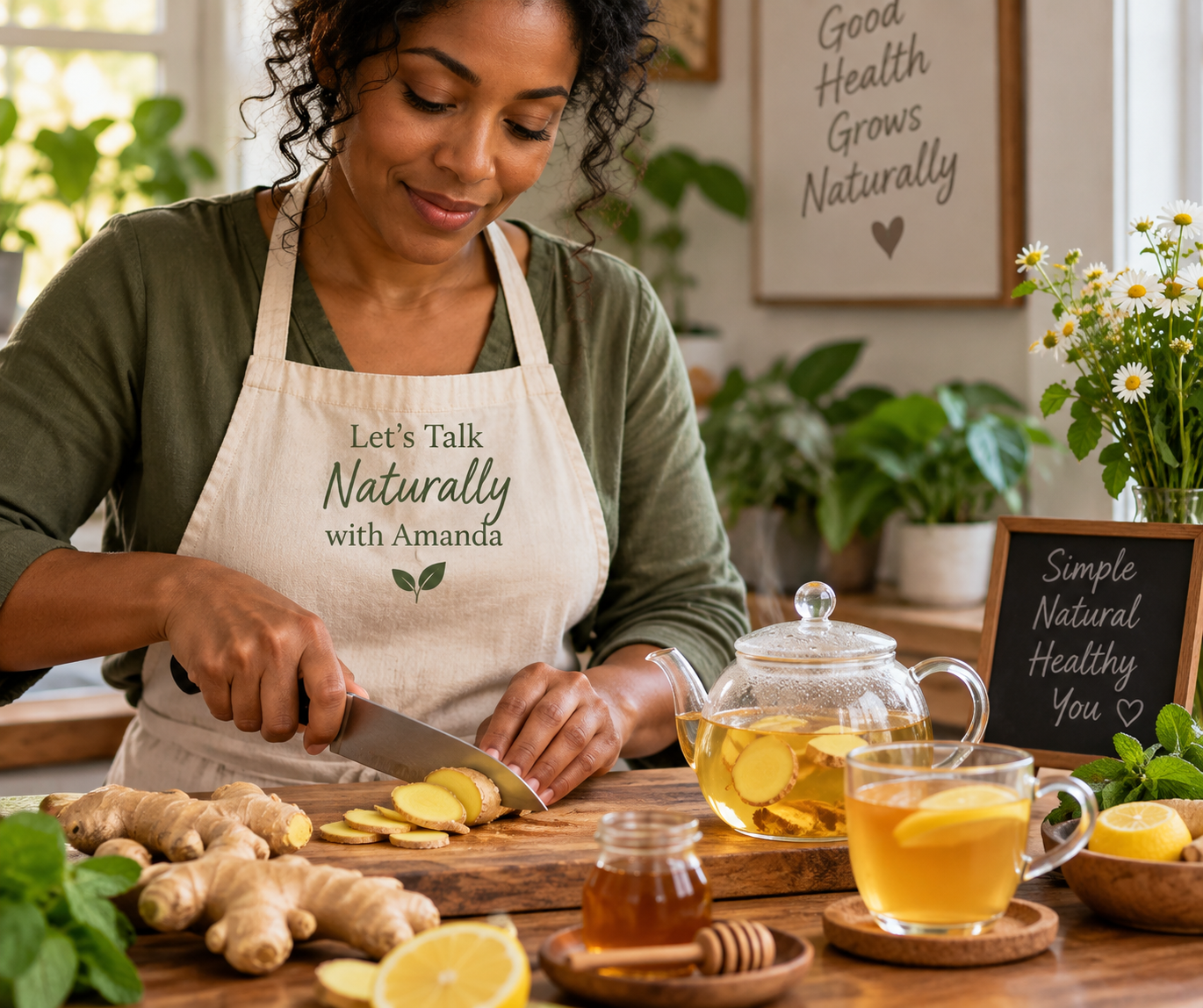
Fresh Ginger Tea
Wash a small piece of fresh ginger and slice or grate it.
Add it to hot water and allow it to steep for approximately 5 to 10 minutes. A stronger tea can be made by using more ginger or allowing it to steep longer.
Some people add lemon or a small amount of honey according to taste.
There is no need to make the drink painfully strong for it to be useful.
Use Ginger in Food
Fresh ginger can be added to:
soups and broths;
stir-fries;
marinades;
fish and meat dishes;
vegetables;
sauces;
baked foods; and
homemade drinks.
Using herbs and spices as part of ordinary food is one of the oldest forms of natural living.
Ginger in Smoothies and Fresh Drinks
A small piece of fresh ginger can also be blended into fruit or vegetable drinks.
Because raw ginger has a powerful flavour, starting with a small amount is usually more pleasant than adding a large quantity.
What About Ginger for the Hair and Scalp?
This is where traditional practice and modern research become particularly interesting.
Ginger has traditionally been used in some East Asian hair-loss and hair-care practices, and ginger extracts are still included in some commercial hair products.
But the popular claim that ginger directly stimulates hair growth is not supported by good clinical evidence.
In fact, a laboratory study examining 6-gingerol, one of ginger's major active constituents, found that it inhibited the elongation of cultured human hair follicles and suppressed hair growth in an animal model.
That does not mean putting ordinary ginger into a hair preparation will automatically make someone's hair fall out.
The study examined a particular ginger compound under controlled experimental conditions.
But it does mean we should be cautious about advertising ginger as a scientifically proven hair-growth stimulant.
Ginger and Scalp Care
Ginger contains compounds that have demonstrated interesting antimicrobial, antioxidant and anti-inflammatory properties in research.
That has contributed to its reputation in traditional scalp preparations.
However, evidence for topically applied ginger in humans remains limited. A systematic review examining topical ginger found only a small number of clinical studies and concluded that stronger research and better safety evidence were needed.
So if someone has dandruff, psoriasis, fungal infection, eczema or another persistent scalp condition, ginger should not automatically be treated as a substitute for appropriate treatment.
This connects with something we have discussed before:
Not all that flakes is dandruff.
Understanding what is causing a scalp problem matters more than simply applying stronger and stronger remedies.
Natural Does Not Mean Use Without Caution
Ginger is natural.
It is also biologically active.
That distinction matters.
When taken orally, ginger can sometimes cause heartburn, abdominal discomfort, diarrhoea, or irritation of the mouth and throat.
People taking medications should also discuss regular medicinal or supplemental ginger use with a healthcare professional because herbs and medicines can sometimes interact.
Pregnant women considering concentrated ginger supplements should likewise discuss them with an appropriate healthcare professional, even though ginger has been widely studied for pregnancy-related nausea.
Topical use deserves caution as well.
Fresh ginger can feel very hot or irritating on sensitive skin. A burning sensation should never be treated as proof that a remedy is "working."
If someone chooses to experiment with ginger cosmetically, using a diluted preparation and testing a small area first is more sensible than applying concentrated raw ginger juice over a large area.
And if irritation develops, wash it off.
Traditional Wisdom and Modern Knowledge Can Exist Together
Sometimes conversations about natural remedies become divided into two extremes.
One side says:
"Our ancestors used it, so it must cure everything."
The other says:
"If it hasn't been proven in a modern clinical trial, it has no value."
Neither approach tells the whole story.
Traditional knowledge gives us centuries of human observation, cultural experience and practical use.
Modern science gives us tools to investigate those observations, identify active compounds, measure effects, recognize limitations and discover risks that may not have been understood before.
We do not have to choose one and throw away the other.
We can learn from both.
The Healthy Choice
Ginger is more than a fashionable "superfood."
It is an ancient spice, a traditional household remedy, an everyday food ingredient and a plant that continues to attract serious scientific research.
Evidence is strongest for some uses, such as helping certain forms of nausea, while other popular claims remain uncertain or unsupported.
And that is perfectly all right.
A natural remedy does not have to cure everything to be valuable.
Use ginger because you enjoy it in your food.
Enjoy a warm cup of ginger tea.
Learn about the traditions surrounding it.
Pay attention to what modern research discovers.
And most importantly, understand both what a natural remedy can do and what it cannot yet be proven to do.
That is how traditional knowledge continues to grow rather than disappear.
Nature gives us the plant. Tradition gives us experience. Research helps us understand it.
Let’s Talk Naturally with Amanda — exploring traditional remedies, natural living and the knowledge behind the plants we use every day..

Small Steps Create Big Shifts
It All Begins Here
Confidence doesn’t always arrive with a bold entrance. Sometimes, it builds quietly, step by step, as we show up for ourselves day after day. It grows when we choose to try, even when we’re unsure of the outcome. Every time you take action despite self-doubt, you reinforce the belief that you’re capable. Confidence isn’t about having all the answers — it’s about trusting that you can figure it out along the way.
The key to making things happen isn’t waiting for the perfect moment; it’s starting with what you have, where you are. Big goals can feel overwhelming when viewed all at once, but momentum builds through small, consistent action. Whether you’re working toward a personal milestone or a professional dream, progress comes from showing up — not perfectly, but persistently. Action creates clarity, and over time, those steps forward add up to something real.
You don’t need to be fearless to reach your goals, you just need to be willing. Willing to try, willing to learn, and willing to believe that you’re capable of more than you know. The road may not always be smooth, but growth rarely is. What matters most is that you keep going, keep learning, and keep believing in the version of yourself you’re becoming.

Turn Intention Into Action
It All Begins Here
Confidence doesn’t always arrive with a bold entrance. Sometimes, it builds quietly, step by step, as we show up for ourselves day after day. It grows when we choose to try, even when we’re unsure of the outcome. Every time you take action despite self-doubt, you reinforce the belief that you’re capable. Confidence isn’t about having all the answers — it’s about trusting that you can figure it out along the way.
The key to making things happen isn’t waiting for the perfect moment; it’s starting with what you have, where you are. Big goals can feel overwhelming when viewed all at once, but momentum builds through small, consistent action. Whether you’re working toward a personal milestone or a professional dream, progress comes from showing up — not perfectly, but persistently. Action creates clarity, and over time, those steps forward add up to something real.
You don’t need to be fearless to reach your goals, you just need to be willing. Willing to try, willing to learn, and willing to believe that you’re capable of more than you know. The road may not always be smooth, but growth rarely is. What matters most is that you keep going, keep learning, and keep believing in the version of yourself you’re becoming.

Make Room for Growth
It All Begins Here
Confidence doesn’t always arrive with a bold entrance. Sometimes, it builds quietly, step by step, as we show up for ourselves day after day. It grows when we choose to try, even when we’re unsure of the outcome. Every time you take action despite self-doubt, you reinforce the belief that you’re capable. Confidence isn’t about having all the answers — it’s about trusting that you can figure it out along the way.
The key to making things happen isn’t waiting for the perfect moment; it’s starting with what you have, where you are. Big goals can feel overwhelming when viewed all at once, but momentum builds through small, consistent action. Whether you’re working toward a personal milestone or a professional dream, progress comes from showing up — not perfectly, but persistently. Action creates clarity, and over time, those steps forward add up to something real.
You don’t need to be fearless to reach your goals, you just need to be willing. Willing to try, willing to learn, and willing to believe that you’re capable of more than you know. The road may not always be smooth, but growth rarely is. What matters most is that you keep going, keep learning, and keep believing in the version of yourself you’re becoming.